Truro
OS Grid ref:- SW 825445
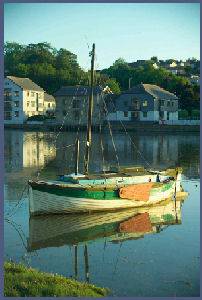 The only city in the entire county of Cornwall, Truro stands amidst rolling green hills where the Kenwyn and Allen rivers combine to become the Truro River.
The city has a colourful history which stretches back over nine hundred years. The earliest records and archaeological findings of a permanent settlement in the Truro area originate from Norman times. The name derives from a Norman castle founded on the site by Richard de Luci, Chief Justice of England , which now no longer exists. The Cornish 'Tre Ru' translates as castle on the water, although an alternative theory is that the name is derived from the "three streets" - Tru-ru.
The town was established where the three rivers, the Kenwyn, Allen and Glasteinan (or Tinney) - converge to form the Truro River, which flows into the River Fal. By the beginning of the fourteenth century, Truro had developed into an important port and tin mining centre.
Most of the city centre is Georgian, Regency or Victorian. Lemon Street is a particularly attractive street and is lined with handsome Georgian houses. The street sweeps up from the river towards the granite memorial to the West African explorer Richard Lemon Lander (8 February 1804 - 6 February 1834), by Cornish sculptor Neville Northey Burnard. Richard Lander was one of Truro's most famous sons, who was born in the Fighting Cocks Inn in Truro.
 In St Mary's Street stands Truro Grammar School. Its most famous master was Cornelius Cardew, whose portrait hangs in the City Council chamber. He was also Mayor.
Sir Humphry Davy, historian Richard Polwhele, Admiral Sir Edward Pellew and many others were all educated at the school, which was one of the oldest schools in Britain until it closed in the nineteenth century.
In St Mary's Street stands Truro Grammar School. Its most famous master was Cornelius Cardew, whose portrait hangs in the City Council chamber. He was also Mayor.
Sir Humphry Davy, historian Richard Polwhele, Admiral Sir Edward Pellew and many others were all educated at the school, which was one of the oldest schools in Britain until it closed in the nineteenth century.
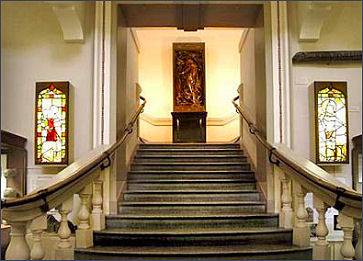
The Royal Cornwall Museum in River Street (pictured right) is well worth a visit. The museum has acquired a wide and varied collection encompassing all aspects of Cornwall's history, culture and environment.
The museum's collections include objects from our oldest ancestors and the earliest civilisations in the world to the present day. Treasures include a 5000 year old jade axe, the 4000 year old Cornish lunulae and the 2500 year old Egyptian Mummy. View the Trewinnard Coach - our ancestors' version of a Rolls Royce, measure up against the Cornish Giant, examine a famous explorer's medicine chest and explore the internationally famous Rashleigh mineral collection with over 1200 beautiful specimens on display. The museum's fine art gallery holds works ranging from Old Masters to contemporary Cornish artists.
The city has a wide variety of shops, including chain stores, speciality shops and markets, the indoor Pannier Market is open year-round with many stalls and small businesses. Truro offers a wide range of accomodation to suit all budgets.
Truro is also noted for its parks and open spaces, including attractive Victoria Gardens, Boscawen Park, which boasts sporting facilities consisting of 8 tennis courts, 3 football pitches, and a cricket pitch and Daubuz Moors, an 18 acre wildlife area situated off Moresk Road. Pleasure cruises are available along the River Fal to Falmouth and St. Mawes.
Truro Cathedral
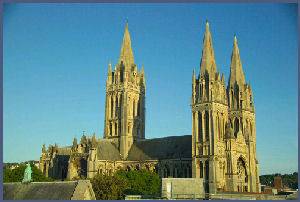 Truro Cathedral was built at the turn of the nineteenth century in the Victorian Gothic Revival style and boasts two 250 feet towers and an elegant spire.
The cathedral took thirty years to construct, from 1880 to 1910, and was built on the site of the old St. Mary's Church, consecrated over six hundred years earlier. In St. Mary's Street the sixteenth century stonework of the old church can still be seen.
Albert Edward, Prince of Wales, the future Edward VII, dressed in masonic regalia, laid the foundation stone in 1880. The cathedral was the first to be built in Britain since St. Paul's in the seventeenth century and is a very unusual building. As the cathedral was built in the middle of an existing city, hemmed in by buildings and space was at a premium, the architect, John Loughborough Pearson, built the nave at an angle of six feet and this bend can be clearly discerned. The design combines the early English style with certain French characteristics, chiefly spires and rose windows.
 The south aisle is the only surviving part of the old St. Mary's church, said to be one of the best examples of medieval church architecture in Cornwall. It is typically Cornish with its granite walls and timber barreled roof. The Chapter House is a more recent addition, being built in 1967.
The large alabaster and marble Robartes Memorial in the North Transept (pictured below left) which once stood in St. Mary's Parish Church, is an elaborate monument to John Robartes (1614) and his wife, Phillipa, John Robartes was a local tin merchant, who lived at nearby Llanhydrock House.
Items of interest include the Baptistry adjoining the south aisle, which contains the Cathedral font and is dedicated to Henry Martyn, a famous missionary who was educted at Truro Grammar School, it has windows with Cornish saints in the upper halves and scenes from the life of Martyn below and the Tinworth Panel, made in terracotta by George Tinworth, a sculptor with an incredible eye for detail.
The heavily carved Bishops Chair, which in Latin is called a 'cathedra' is another item of note. The famous Father Willis organ, was built into the Cathedral during its construction and in consequence is deemed to be acoustically perfect.
The other main organ in Truro Cathedral is a two-manual instrument in the St Mary's Aisle, which came from the former parish church. It was constructed by Renatus Harris and was installed in Truro in 1750 by John Byfield. It was re-installed in the cathedral in 1880, but was significantly rebuilt and reduced in size in 1887 for installation in its current position.
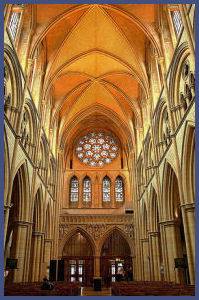
The beautiful three rose windows represent the Trinity. The Lectern was used for the first ever service of Nine Lessons and Carols, instituted by the first Bishop, Edward White Benson, on Christmas Eve 1880. The cathedral's stained glass windows are considered to be the finest examples of Victorian stained glass.
A 15-year restoration programme commenced in 2004
Shop and cafe. Free guide tours are available.
Places of Interest in Truro
*The Royal Cornwall Museum in River Street houses a geological collection along with other highly interesting exhibits relating to Cornwall's past, including archaeology, mining and natural history, the museum also contains artefacts from ancient Egypt and Japan.
*The Hall for Cornwall is now the principal entertainment centre for the county and hosts operas and ballets.
*Bosvigo three acres of mainly herbaceous gardens which are best seen in summer. Open March - Sept, Thurs - Sat, 11am - 6pm.
*Trewithen Gardens Grampound Road, near Truro. Rare trees and shrubs, plants for sale. Open March - Sept, Mon - Sat, 10am - 4.30pm, and Sun in April and May.