The Beast of Bodmin Moor
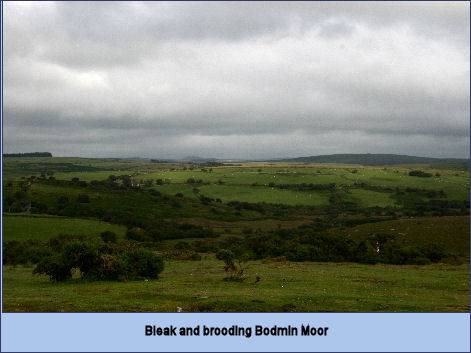
Bodmin Moor, with its brooding atmosphere and mysterious stone circles has inspired many legends.
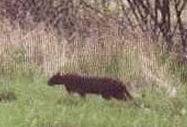 There have been numerous reported sightings of a
big cat on Bodmin Moor since as far back as the 1980's. In the early 1990's, when farmers found their animals savaged, speculation began to circulate in the national press as to
whether a big cat, a panther or perhaps a leopard was living wild on the moor. Photographers had captured on film what appeared to be a large catlike creature prowling the moor
in the gathering dusk.
There have been numerous reported sightings of a
big cat on Bodmin Moor since as far back as the 1980's. In the early 1990's, when farmers found their animals savaged, speculation began to circulate in the national press as to
whether a big cat, a panther or perhaps a leopard was living wild on the moor. Photographers had captured on film what appeared to be a large catlike creature prowling the moor
in the gathering dusk.
There have been around sixty big cat sightings recorded in the area since 1983. The beast is described by those claiming to have seen it as looking like a Black Panther or big cat with large white-yellow eyes and it's size ranges from 3-5 feet long for the body, with a tail of roughly 18-24 inches. The creature makes the usual hissing and growling sounds of a large cat such as a panther but has also been reported to have made noises which sound like a woman screaming.
The Ministry of Agriculture commissioned an investigation in 1995, which concluded that there was 'no verifiable evidence' that the beast existed, and concluded that that the mauled sheep could have been attacked by animals common in Briitain. However the government report also stated that "the investigation could not prove that a 'big cat' is not present."
Despite their report many of the locals remain convinced that there a big cat, or perhaps a number of them, roaming wild on the moor. In October 1997, officials from Newquay Zoo claimed to identify pawprints left in mud to the south of Bodmin Moor as the tracks of a puma.
 Shortly afterwards, the skull of a big cat with large fangs was in fact discovered in the River Fowey by a fourteen year old boy and sent to the Natural History Museum for identification, who following a thorough examination revealed it to be that of a young Indian leopard. However, closer inspection revealed that inside the skull was the egg case of a tropical cockroach, a species that cannot possibly survive in the wild in Britain, the back of the skull contained knife marks, such as can often be found on leopard skin rugs. The museum therefore concluded that far from being the remains of the Beast of Bodmin Moor the skull had in fact been taken from a leopard-skin rug.
A video, released in August, 1998, appears to be of a large cat measuring around three feet. Some authorities are of the opinion that it could depict a species of wild cat thought to have become extinct in Britain over a century ago. In 1998, video footage was released showing a black animal around three and a half feet long. The video was described by curator of Newquay Zoo and wild cat expert as 'the best evidence yet' that big cats do indeed roam Bodmin Moor
A number of farm animal mutilations on Bodmin Moor occured in November 1999, when a calf and two sheep were attacked and torn apart by an unknown creature, a high tech option was introduced into the quest for the Beast of Bodmin Moor and a motion-activated infrared video camera was installed on the moor.
Large claw marks found at Trewithen Gardens near Truro in 2011, backed up a sighting of head gardener Gary Long, who glimpsed a "very large black cat-like creature".
In 2014 an amateur photographer captured what he believes may be the legendary beast on film, Henry Warren aged 19, was taking pictures in fields near his home on the edge of Bodmin Moor when a large cat like creature leapt out into the field front of him. The student managed to take several frames before the animal dissapeared into undergrowth.
Mr Warren has since stated ' "It was absolutely massive and was hoping up and down like a large cat. There's no way it could have been fox, a dog or anything else like that. "It ran around 60 metres in just a few seconds and was leaping in the air with it's front two legs first."
See also:-