Blisland
OS Grid ref:- SX1073
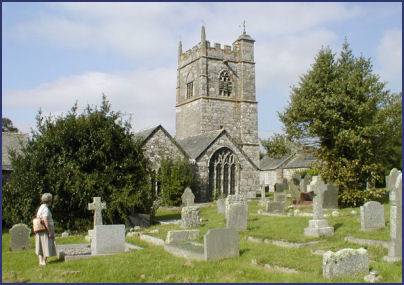 The picturesque village of Blisland, a village of much charm, is known in Cornish as Blyslannon. Blisland lies on the north western slopes of bleak Bodmin Moor and has an entirely different character to the typical Cornish villages.
The old village inn, the 'Blisland Inn' the manor house and a profusion of granite cottages huddle around an attractive green which could fairly be described as the only village green in Cornwall.
The village is mentioned in the Domesday Book of 1086 as 'Glustone' and was held by the King William I in demesne. At the time of King Edward the Confessor it had been held by Earl Harold Godwinson.
The beautiful slate and granite church is dedicated to St. Protus and St. Hyacinth, who were Christian martyrs during the persecution of Emperor Valerian (257-259 AD). It is thought to occupy the site of an earlier Saxon church. The present building dates from the Norman era. The tower dates from the fifteenth century.
The church of St. Protus and St. Hyacinth was a favourites of the poet John Betjeman (1906 - 84), the poet laureate, who described it as 'dazzling and amazing'.
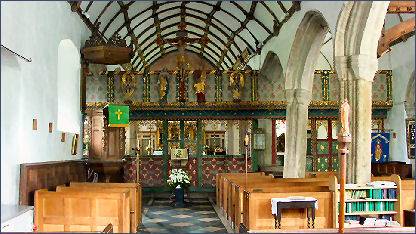 The ornate church boasts a wagon roof with almost two hundred bosses and has a white walled interior. The pulpit,
which is intricately carved, dates from the seventeenth century. The church was updated during the fifteenth century in the Perpendicular Gothic style and underwent extensive interior remodelling in the nineteenth century to to include a stunning Renaissance style altar and a colourful decorated rood screen.
The ornate church boasts a wagon roof with almost two hundred bosses and has a white walled interior. The pulpit,
which is intricately carved, dates from the seventeenth century. The church was updated during the fifteenth century in the Perpendicular Gothic style and underwent extensive interior remodelling in the nineteenth century to to include a stunning Renaissance style altar and a colourful decorated rood screen.
The extensive restoration includes work by Ninian Comper and F. C. Eden. According to Betjeman: "As a restoration and even improvement on a medieval church, this holy and peaceful place ... can hardly be bettered in the kingdom.". In the church is the early fifteenth century brass of John Balsam, a former rector.
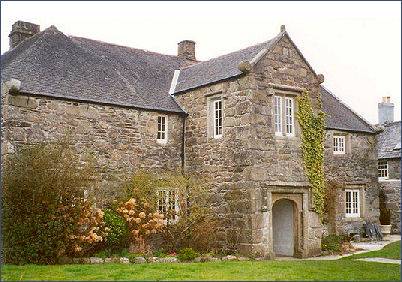
Imposing Blisland Manor House (pictured below left) , which stands at the edge of the village green, dates from the sixteenth century but has later alterations. The Manor was owned by the Billing family for many years, they were also landowners at nearby St Breward and elsewhere.
 The cosy Blisland Inn in the village, a much favoured stopping off point for walkers in the area, was voted CAMARA pub of the year in 2001. The Blisland Inn has developed a reputation for its real ales and the atmosphere of a real welcoming local pub. It is conveniently positioned at the head of the Camel Trail.
 The village has two quaint stone bridges over the De Lank River, which runs down from Brown Willy and is a tributary of the River Camel.
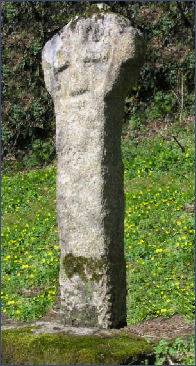
At the entrance to Blisland stands St Pratt's cross and holy well (OS grid reference - SX 10377310) from where a feast day procession takes place each September. Protus' name is sometimes spelled Proteus, Prothus, Prote, and Proto. His name was corrupted in England as Saint Pratt. Water from the well is used as the source of holy water for Christenings in the church.
The ancient upright granite cross, (pictured right) which marks the site of the well, has a 'wheel' head and is set in a granite base. The monument is unusual in that combines the roles of a wayside cross with a holy-well marker. The cross is situated on an important local route linking Blisland and the neighbouring villages of western Bodmin Moor with the major route through Cornwall.
A prehistoric stone circle known as the Trippet stones stands on Blisland Manor Common, dating from the bronze age, it is believed to have been used for performing ceremonies and rituals. The stone circle has a diameter of 104.6 feet (31.9 m). It is composed of 8 upright granite stones with four others that have fallen. It has been suggested there may originally have been as many as twenty-six menhirs that many of which were by stone-breakers.
On Hawkstor Down there is a henge monument known as the Stripple stones. A short distance from Blisland on Pendrift Common, stands Jubilee Rock at 213m above sea level which provides excellent views over Bodmin Moor.
Nearby Lavethan manor is listed in the Domesday Book of 1086 but most of the current building dates from 1653.
The Camel Trail
Covering 16 miles (24km) The Camel Trail follows the course of the old railway line along the Camel estuary between Blisland and Padstow, covering 16 miles (24km) The trail can be joined at various points along its route.
Open to cyclists and horse riders as well as walkers. The river itself is home to a variety of wading birds. The trail passes through some superb countryside.