Portreath
OS Grid ref:- SW653454
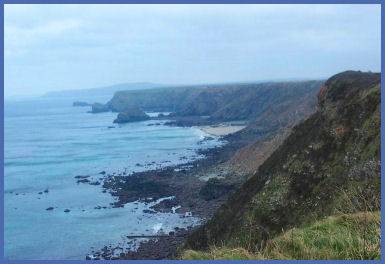 The pleasant coastal village of Portreath, located four miles from the town of Redruth, nestles at the mouth of a picturesque valley.
The poular and secluded sandy beach is suitable for surfing, windsurfing and bathing and has a stream running down to the sea as well as rockpools. A tidal swimming pool lies under the shelter of the harbour wall. Dogs are not permitted on the beach from Easter Day to 1st October. There are lifeguards in season and the beach has a closely situated car park.
Portreath was once a busy port, used for the import of coal and export of copper. The harbour under the cliffs at Portreath has a very narrow entrance, it was bulit in 1760 by Francis Basset de Dunstanville, a local benefactor, to enable easier loading and unloading of copper ore. In 1809, one of the earliest railways in the United Kingdom, and the first in the county of Cornwall, was built from Portreath to the St Day mine, which lies around five miles inland. The final steep section that lowered the wagons down to the harbour is still visible today.
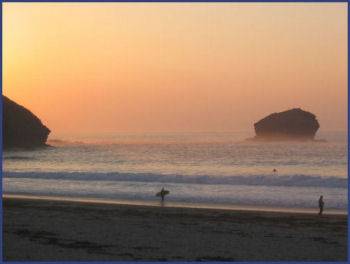 Portreath offers cafes, restaurants and a range of shops, restaurants and a number of pubs. The dramatic north cliffs provide panoramic scenery with distant views over to St. Ives . The section of the north coast path between Portreath and St. Agnes has been described as one of the finest walks in Cornwall.
Some of the old tram roads have been converted into cycle paths, Portreath tramroad runs for seven and a half miles to Croft Handy near St. Day, in their heyday it served the copper mines.
Smugglers Cottage is one of the oldest buildings in the area, a former capson house, it dates to 1617. It was later used as a retreat by the Bassets of Tehidy who created a miniature Brighton there during the 1780s. Several rock-cut baths were t hewn in the rocks and cliff-face for female members of the family. Cornwall Gold at Portreath is an 18 acre park where visitors enjoy substantial free parking and free admission to the grounds.
Nearby Tehidy Country Park , situated about a mile and a half from Portreath, is the largest single stretch of woodland in west Cornwall and offers attractive woodland walks and cycle trails. The park has a varied range of wildlife. There are lakes, ponds and cascades, and a delightful series of weirs on the stream that empties from the large main lake.
Cornwall Gold
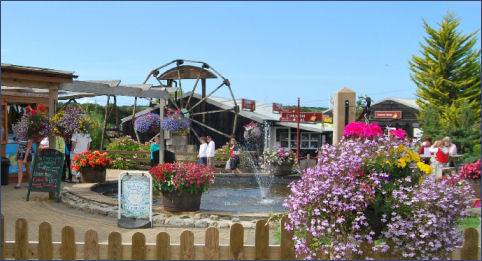 Cornwall Gold, at Portreath is an 18 acre park occupying the site of the former Tolgus tin mine where visitors enjoy substantial free parking and free admission to the grounds.
Colourful floral displays decorate the twists of the Tolgus Stream that runs through the centre of the park and leads around paths where many retail, family and heritage outlets can be enjoyed by visitors.
Following the paths into the main entrance of Cornwall Gold the visitor is immersed into the home of Cornish Jewellery, with amazing displays and an opportunity to see the jewellery being made.
A collection of designer and bespoke jewellery pieces from top brands to local designers are on offer. Commission pieces can also be taken. There are displays of commissioned college and established designer pieces as well as a stunning 'Cornish Collection' range.
The park offers a diverse selection of activities, from looking around the old mine machinery from the Tolgus tin mine, panning for gold, Haunted Ride 4D film and crazy golf course, shops selling gold jewellery, Cornish silver, crystal gifts, candles and more.
Facilities include a restaurant and Coffee Bar. The Redruth Old Cornwall Society Town Museum is on the same site.
Visitor Attractions in Cornwall