Bodmin
OS Grid ref:- SX071665
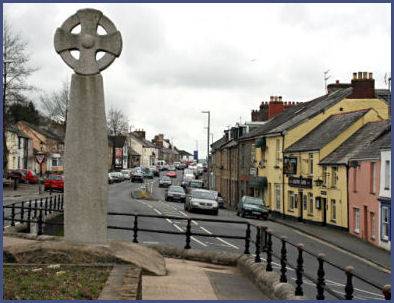 The historic town of Bodmin, known in Cornish as Bosvenegh, was once the county town of Cornwall and is the only Cornish town to be recorded in the Domesday Book. The name is said to derive from the Cornish Bodminachau, meaning 'the town of the monks'.
Bodmin's characterful streets boast a number of buildings of historic interest , including the Turret Clock, which marks the site of the ancient Butter Market, the Assize Hall, Shire Hall, which now serves as the tourist information centre and Bodmin Gaol, which has now been converted into a museum and is open to the public.
Bodmin Beacon towers above the town, the 144 feet high obelisk is dedicated to Lt. Gen. Sir Walter Raleigh Gilbert (1785-1853), a descendant of the Elizabethan sailors Raleigh and Gilbert. The Bodmin Beacon Local Nature Reserve contains 83 acres of public land and at its highest point it reaches 162 metres.
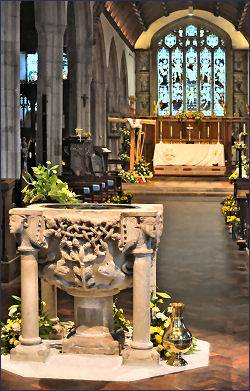 St. Petroc's Church (right), the Parish Church of Bodmin, is the largest church in the county and dates from the Norman era although earlier churches dating back to the sixth century have occupied the site. The church was rebuilt in the fifteenth century in the Cornish perpendicular style and heavily restored in the nineteenth century. St. Petroc was probably born in South Wales, he primarily ministered to the Britons of Devon and Cornwall. The earliest Life of St. Petroc claims that he was the son of an unnamed Welsh king, the twelfth century version known as the Gotha Life, written at Bodmin, identifies that king as Glywys of Glywysing and Petroc as a brother of Gwynllyw and uncle of Cadoc.
The large and elaborate font is Norman and dates to the twelfth century while the three, late fifteenth century misericords have at some point been taken from their original stalls and fitted into the lectern. The relics of St. Petroc are kept in an ivory casket which dates to the twelfth century. They were at one time stolen and taken to Brittany by an Augustinian monk but were later recovered by Prior Roger of Bodmin, who was aided in his enterprise by King Henry II. There are a number of interesting monuments, most notably that of Prior Vivian which was formerly in the Priory Church.
All that now remains of the once great Bodmin Abbey is a few fragments and a fishpond. The legends of St Petroc associate him with monasteries in Padstow and Bodmin but that at Bodmin may have been founded as a daughter house of Padstow (also called Petrockstow or Aldestow) after his death. St Guron is said to have preceded him here. The foundation of the monastery is also attributed to the Saxon King Athelstan though it probably existed before his time, and was destroyed in a Danish raid in 981 AD. Domesday Book records that parts of its lands had been taken from it by Robert, Count of Mortain, half-brother of William the Conqueror, while others had been retained.
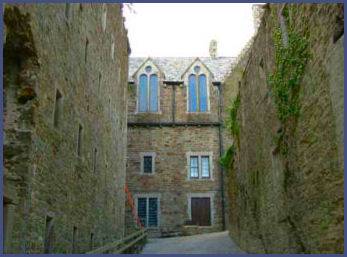 The Barracks of the Duke of Cornwall's Light Infantry are now housed in the Regimental Museum, where the regiment's interesting history is related, the museum also contains an excellent collection of small arms and machine guns.
The Bodmin and Wenford Railway is Cornwall's only standard gauge railway still operated by steam locomotives and the trains and runs through some superb Cornish scenery. The Railway is typical of a branch line in the 1950's. Great Western steam tank engines are the main locomotives to be seen here but diesel traction is also used, particularly on Saturdays. The main station on the line is at Bodmin General. where the engine sheds are situated, there is also a Souvenir shop and refreshment room in the restored station buildings.
Bodmin Gaol, (pictured left) is purported to be haunted, it dates to 1778 and was built to replace the Debtor's Prison, which now serves as the Hole-In-The-Wall Public House. It was the first prison in the country to have separate cells and bears the further distinction of being the site of the last public hanging in Britain, which took place in 1909. A total of 55 people were hanged at the jail, of which 51 were public hangings. This was regarded as major spectator sport in the nineteenth century. Exhibits include some of the more notorious prisoners with details of their crimes. Tours of the dungeons are available, there is also a restaurant and licensed bar on site.
The Coutroom Experience
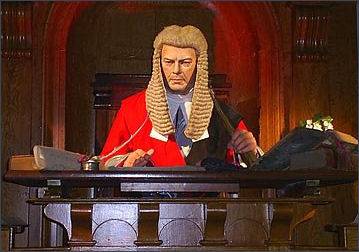 A Victorian murder mystery which is set in the original courtrooms of Bodmin's Shire Hall where visitors play the part of the jury in the Charlotte Dymond murder trial.
In 1844 the lifeless body of local girl Charlotte Dymond was found in a ditch on the slopes of Rough Tor on Bodmin Moor, Cornwall’s highest peak. Her boyfriend, Matthew Weeks, was later tried and found guilty of her murder and was subsequently hanged at Bodmin Jail.
Considerable circumstantial evidence supported this verdict, Matthew Weeks had been observed walking with Charlotte up to the moor on the fateful day of her death and was later seen wearing muddy and torn clothes. It was also discovered that Charlotte had been having an affair with 26 year old Thomas Prout.
It is argued that Matthew Weeks was of low intelligence and this may have been exploited by the police to gain a confession to provide a scapegoat to satisfy the considerable anger that was felt locally. In addition, Week's confession was not worded in such a way as could be expected of a farm worker.
The Courtroom Experience features an interactive tour of the cells and the original courtroom which culminates in a re-enactment of the Victorian trial in which visitors are invited to decide the verdict.