Launceston
OS Grid ref:- SX335845
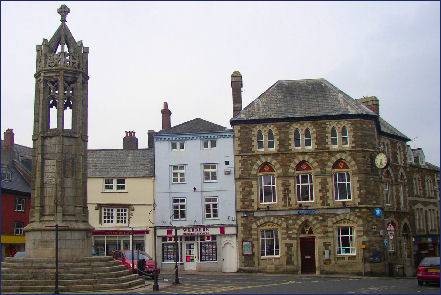 Launceston is the ancient capital of Cornwall and was founded in the eleventh century when William the Conqueror gave his half brother, Robert, Count of Mortain, the land surrounding a hill site already fortified by his predecessor the Saxon king Edward the Confessor. The town boasts streets of imposing Georgian houses, has a variety of accommodation and an abundance of shops, restaurants and pubs. The name Launceston is a combination from the Cornish language:- Laun meaning cleared space; Sen meaning Saint; and ton, town.
In the Middle Ages Launceston was the only walled town in Cornwall, fragments of the walls still stand in the parklands below the castle and at Southgate, an grand Norman arch which was one of the three original entrances to the town. Launceston has varying types of architecture, from Tudor to modern day.
St. Mary Magdalene's, Launceston's parish church is first mentioned in 1080 and it probably dates back to around the same time as the castle. The second building to occupy the site was constructed in 1380, its tower still remains. This second church was built by Edward, the Black Prince; the eldest son of King Edward III and the first Duke of Cornwall.
The present building, was constructed in 1511 by Sir Henry Trecarrell in memory of his infant heir who was tragically drowned. The building is unique in that it is said to be the only church in England built of carved Cornish granite, almost every available surface on its exterior is adorned with carvings of legendary figures, animals, plants and fruit. Below the ornate east window is a carved figure of Mary Magdalene.
Dating back to 1753, Lawrence House, a fine Georgian house, it is owned by the National Trust and leased to Launceston Town Council, it is used as a local museum and civic centre. Built by former Mayor of Launceston, Humphrey Lawrence, the house is located on Castle Street, a street which John Betjemen described as 'having the most perfect collection of eighteenth century townhouses in Cornwall'.
Launceston Castle
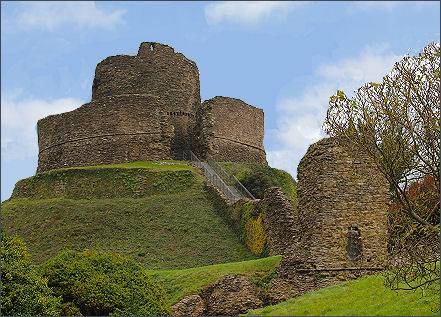
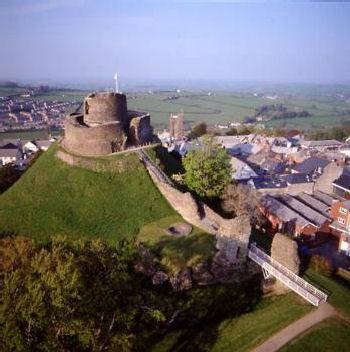 Launceston Castle stands on a large natural mound beside the River Kelsey. The soaring keep leans and the curtain walls are now in ruins.
The castle was founded by Robert of Mortain, the half brother of the formidable William the Conqueror in the eleventh century, possibly as early as 1067. The first mention of the castle occurs in the Domesday Book of 1086, where it is recorded "The Earl himself holds Dunhevet...the Castle of the Earl is there."
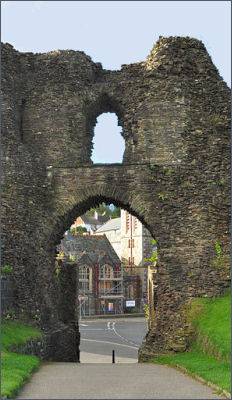 Originally, the castle was known as Dunheved and was first constructed as an earthwork motte and bailey castle, with wooden defences. It guarded the main route into Cornwall and became the administrative centre for the Earls of Cornwall. In the late twelfth century a circular stone keep was constructed on top of the motte.
In the thirteenth century, Richard, Earl of Cornwall, a younger brother of King Henry III, rebuilt the castle in stone replacing the original timber palisades with stone curtain walls. The round tower, which has two rooms, was built from a darker stone than that used on the rest of the castle. The tower top can be reached via an internal staircase and offers stunning views of the surrounding town and landscape, encompassing Bodmin Moor and Dartmoor. A new great hall was constructed continued in use until the early seventeenth century as an Assize Hall. Substantial gatehouses were also constructed.
In 1272, the administrative centre of Cornwall was moved to Lostwithiel, resulting in a decline in the importance of Launceston Castle.
During the reign of the boy king Edward VI, 8 Cornishmen were taken at gunpoint to Launceston Castle in 1548, where they were hung, drawn and quartered. Resentment had been building up in Cornwall ever since the 1530s, when Henry VIII broke from Rome and established the Church of England. Henry VIII had already put down a huge uprising in the north of Cornwall in 1536 and during the reign of his son Edward VI discontent at the religious changes was rife.
 The people of the village of St Keverne learnt that William Body, the archdeacon of Cornwall, had begun removing images from the church in Helston. St. Keverne lay in what was once the heartland of Cornish-speaking west Cornwall. Led by their parish priest, Martin Geffrey, they set off for Helston, joined by many along the way.
William Body sought refuge from the mob in a nearby house but was dragged out by the crowd and murdered. Government retribution was swift and brutal, the mob, which had swelled to around 3,000 people, was dispersed by the arrival of Sir William Godolphin and other justices of the peace, and eight of the Cornishmen were taken to Launceston for execution.
The people of the village of St Keverne learnt that William Body, the archdeacon of Cornwall, had begun removing images from the church in Helston. St. Keverne lay in what was once the heartland of Cornish-speaking west Cornwall. Led by their parish priest, Martin Geffrey, they set off for Helston, joined by many along the way.
William Body sought refuge from the mob in a nearby house but was dragged out by the crowd and murdered. Government retribution was swift and brutal, the mob, which had swelled to around 3,000 people, was dispersed by the arrival of Sir William Godolphin and other justices of the peace, and eight of the Cornishmen were taken to Launceston for execution.
Cornwall was staunchly Roylaist during the Civil War and supported the cause of King Charles I, Launceston Castle, however, had declined to such a poor state of repair that the Parliamentarian army did not bother to damage it further when they gained control of it from the supporters of the king.
Launceston Castle has also served as a prison. George Fox, founder of the Quaker movement , was perhaps the most famous prisoner. In the reign of King Charles II, he suffered harsh confinement when he was imprisoned in the castle in for eight months during 1656.
By the mid seventeenth century, the castle stood in virtual ruins, apart from the North Gatehouse. The Duke of Northumberland subsequently had the castle area landscaped and turned it into a public park. Only the ruin of the stone keep now remains, the public garden occupies what was once the bailey.
Launceston Castle is now in the care of English Heritage. An exhibition room display traces 1,000 years of the castle's history and features finds from excavations at the site.
Places to Visit
*Launceston Steam Railway runs for one and a quarter miles along the Kensey Valley and operates from a terminus below the castle. Open:- end of May - mid Oct, Easter and Christmas.
*Lawrence House Museum a handsome period house, containing exhibits relating to the history of the town and neighbouring areas. One of Cornwall's best museums.
*The Tamar Valley Donkey Sanctuary situated just of the A390 near Callington.
Tamar Valley Otter Sanctuary The Otters are bred and reintroduced back into the wild. Visitor centre and nature trail with wildfowl and deer. Situated on the B3254 to Bude.