Morwenstow
OS Grid ref:- SW 851766
 Morwenstow, known in Cornish as
Lannvorwenna, lies on the Cornish coast about seven miles to the north of the town of Bude and close to the Devon border. It comprises of several Hamlets including Shop, Eastcott,
Milton, Woodford, Gooseham, Woolley, and Youlestone.
Morwenstow, known in Cornish as
Lannvorwenna, lies on the Cornish coast about seven miles to the north of the town of Bude and close to the Devon border. It comprises of several Hamlets including Shop, Eastcott,
Milton, Woodford, Gooseham, Woolley, and Youlestone.
Morwenstow's claim to fame lies in the fact that it was home to the eccentric, and reputedly opium-smoking, vicar and poet Robert Stephen Hawker (1803 - 1875), the son of a Cornish curate, who composed Cornwall's regional anthem 'The Song of the Western Men' and was the originator of the Harvest Festival. He is said to have had ten cats which often followed him to church.
 "Parson Hawker", as he was known to his parishioners, was something of an eccentric, both in his clothes and his habits. He adored bright colours and it seems the only black things he wore were his socks.
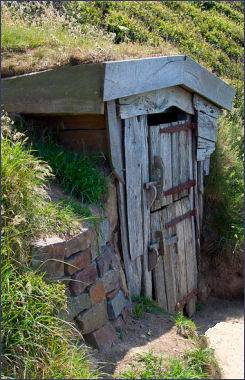
Morwenstow was in the past a haven for wreckers who resorted to setting up dodgy lights to lure sailors to their doom, before plundering the ships cargo. The Rev Hawker frequently kept watch eye over ships travelling through these dangerous waters from a wooden hut which he fashioned from driftwood. Hawker's Hut (pictured right) still perches precariously at the edge of one of the tallest cliffs in the area, looking out to the Island of Lundy. The hut is now owned by the National Trust - it is the smallest property owned by the Trust. Hawker spent many hours there composing his poems and letters and used it to entertain both Alfred Lord Tennyson and Charles Kingsley.
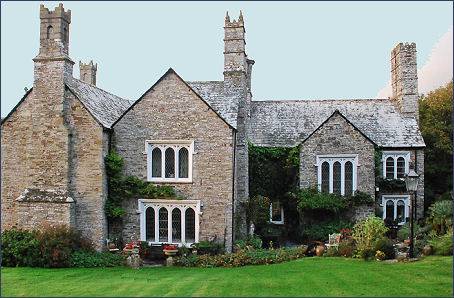
Hawker dressed in a combination of claret-coloured coat, blue fisherman's jersey, long sea-boots, a pink brimless hat and a poncho made from a yellow horse blanket, which he claimed was the ancient habit of St Padarn. He built himself a remarkable vicarage, (above left) with chimneys modelled on the towers of the churches in his life. The old kitchen chimney is a replica of Hawker's mother's tomb.
 Morwenstow church dates back to Norman times and is dedicated to St Morwenna and St John the Baptist. It was appropriated by the Bishop of Exeter to St John's Hospital at
Bridgewater before 1291. The present building replaced an earlier Saxon structure which occupied the site. An ornately carved screen dating from 1575 separates the chancel from the nave. The church has an interesting Norman doorway.
Morwenstow church dates back to Norman times and is dedicated to St Morwenna and St John the Baptist. It was appropriated by the Bishop of Exeter to St John's Hospital at
Bridgewater before 1291. The present building replaced an earlier Saxon structure which occupied the site. An ornately carved screen dating from 1575 separates the chancel from the nave. The church has an interesting Norman doorway.
On the north wall is a fragment of a late fifteeenth or early sixteenth century mural . The painting depicts a woman holding a scroll in her left hand with her right arm raised in blessing over a kneeling monk and is beleived to represent St Morwenna.
One of the memorials in the churchyard is the white figurehead of the "Caledonia", whose captain and crew lie buried there. The ship was wrecked on the perilous rocks of Higher Sharpnose in 1843. Also in the churchyard is a granite Celtic cross which is beleived to have been moved from a nearby moor by Rev. Hawker to commemorate the death of his first wife, Charlotte.
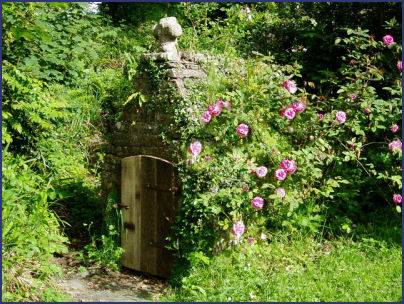
Medieval St John's Well, (pictured above left) which is mentioned in a document dating to the thirteenth century, still supplies baptismal water for the Church of Saints Morwenna and John the Baptist. The small stone building is rectangular in shape with a wooden door and a steeply gabled stone roof. It is situated in a corner of the vicarage garden and used to also supply water to the vicarage. St. John's Well is now cared for by the National Trust. Although the gardens are private there is public access to the well itself from the lane leading down to the house. St. Morwenna’s former well at Mormenstow is in an inaccessible position part-way down the cliff.
Image copyright Thor Beverley
Towns and Villages of Cornwall