Lanhydrock House
OS Grid Reference- SX 085 635
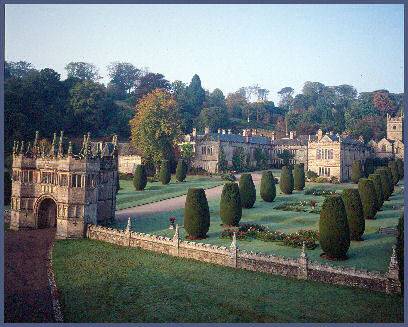 Lanhydrock House, two and a half miles south of Bodmin and overlooking the richly wooded valley of the River Fowey, is the grandest and most popular stately home in the county of Cornwall. Set in a 450 acre estate, The house is reached via a long avenue of sycamores planted in 1648 and is guarded by an elaborate Gatehouse.
The Lanhydrock estate, once a monastic farm, belonged to the Augustinian priory of St Petroc at Bodmin but at the Dissolution of the Monasteries during the 1530s it was sold by the crown. The Glynn family acquired Lanhydrock, the estate then passed by marriage to the Lyttelton family and later still, again through marriage, to Thomas Trenance in 1577.
In 1620, Sir Richard Robartes, a wealthy merchant, purchased the estate Lyttelton Trenance, the son of Thomas Trenance. The Roberts family, later to change their name to Robartes, rose in affluence during the sixteenth century from their interests in the tin trade, as merchants and bankers. In 1624, James I granted Sir Richard a peerage and he became Baron Robartes of Truro.
Robartes began the construction of Lanhydrock House in 1630, the house was designed to a four-sided layout around a central courtyard and built of grey granite. Baron Robartes died in 1624 but work on the building was continued by his son John Robartes, 1st Earl of Radnor, a notable public figure who served as Lord Privy Seal and Lord President of the Council.
 On the outbreak of the Civil War John Robartes declared for the Parliamentarians and set about the garrisoning of Lanhydrock. The Royalists, under the command of Sir Richard Grenville, took control of the estate in the summer of 1644. John, Lord Robartes escaped by sea to Plymouth, though his children were held as prisoners at Lanhydrock. Later in the War Lord Robartes was appointed governor of Plymouth and was instrumental in raising the Royalist siege of the town.
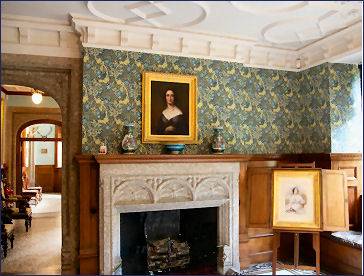
The house was the victim of a disastrous fire in 1881 which destroyed much of the original building, only the crenellated gatehouse and the Long Gallery with its plaster ceiling depicting biblical scenes was one of the few Tudor features to survive. Lady Robartes, then aged 68, was rescued by ladder from an upstairs window, but died a few days later, from shock. The house was rebuilt in grey granite by her grandson, Thomas Charles Robartes, 2nd Baron Robartes and refurbished in the high-Victorian style although it also contains some earlier eighteenth century furniture and tapestries.
The tour of Lanhydrock covers 49 rooms, ranging from the main rooms, with their ornate plaster ceilings, luxuriously furnished in the Victorian style to the maid's bedrooms and the great kitchen, which still contains the original Victorian utensils and equipment. The seventeenth century Long Gallery boasts a remarkable plasterwork ceiling and contains a rare book collection.
The church of St Hydrock stands in the grounds of Lanhydrock House. Parts date back to the late fifteenth century, the building has a chancel, nave, north and south aisles and three-stage battlemented tower with one bell.
Unlike most gardens in Cornwall, Lanhydrock is not located near to the coast, but well inland. The gardens were laid out from the mid nineteenth century onwards.
There are 22 acres of superb gardens at Lanhydrock, consisting mainly of herbaceous borders and formal parterres. The garden with its 30-acres of woodland, was laid out in 1857, but its present format was actually established later on in the Victorian period. A grand atmosphere permeates the entire setting and compliments the brilliant planting of more modern times. Over 120 species of cream and white magnolias compete with the wild flowers which carpet the woodland.
In front of the house, the gardens, enclosed by granite walls, are formal and contain some superb urns modellled by Louis Ballin, Goldsmith to King Louis XIV of France. Behind and above the house is the Higher Garden, it contains trees and shrubs planted in the twentieth century among older specimens. Slopes of camellias, rhododendrons and Himalayan magnolias verge into the woodland beyond and there are stunning sweeping views over the gardens and the valley landscape.
The estate consists in all of 450 acres of woodland and parkland. The house and estate were donated to the National Trust by the 7th Viscount Clifden in 1953.
Historic Buildings in Cornwall