Men an Tol
OS grid ref:- SW 426349
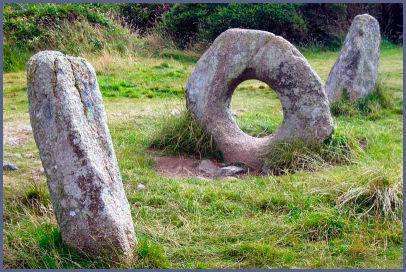 The Men an Tol standing stones are situated in a remote
location on wild moorland near the Cornish village of Madron. The name translates from Cornish as the stone with a hole. Men an Tol dates from the Bronze Age, between
3000-4000 years ago.
The Men an Tol standing stones are situated in a remote
location on wild moorland near the Cornish village of Madron. The name translates from Cornish as the stone with a hole. Men an Tol dates from the Bronze Age, between
3000-4000 years ago.
Archaeologists have suggested that the three stones that make up the Men-an-Tol monument are the remains of a Neolithic tomb because generally, holed stones have been found near the entrances to many such burial chambers.
The enigmatic monument consists of four stones, one of which has fallen, the central holed stone stands betwen two further uprights. The circular stone, known as the 'Crick Stone' or the 'Devil's Eye', which is doughnut shaped, measures 1.3 metres ( 4 feet 6 inches) in diameter.The hole is some 45 cm in diameter.
An old plan of the monument reveals that the three stones once stood in a triangle.
The Cornwall Archaeology Unit (C.A.U.) have recently cleared some of the rampant gorse from around the site and have suggested that the stones may once have formed part of a stone circle which consisted of around twenty uprights and measuring 16.5 metres in diameter.
Local folklore claims properties of healing and fertility to the holed stone, children were passed naked through the hole and drawn on the grass three times against t he sun which was believed to cure for scrofula and rickets. Adults also, seeking a cure from rheumatism or back troubles crawled through the hole nine times against the sun.
Directions
Head South on the B3306 from St Ives. Turn Left at Trevowhan. Just after a right-hand turn signposted for Great Bosullow, a farm track heads off uphill to the left. Park here, and Men-an-Tol is a five minute walk up the track.