St. Michael's Mount
OS Grid ref:- SW515300
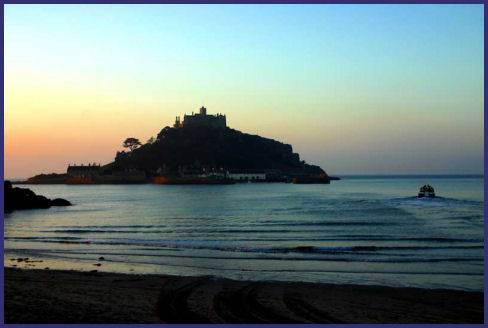 Spectacular St. Michael's Mount near Penzance occupies a granite outcrop which rises dramatically from Mount's Bay and is England's most scenic coastal attraction, a medieval castle with sub tropical hanging gardens and a church perched on top of a rocky island, cut off from the mainland at high tide.
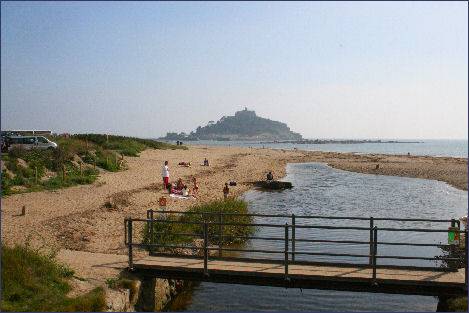
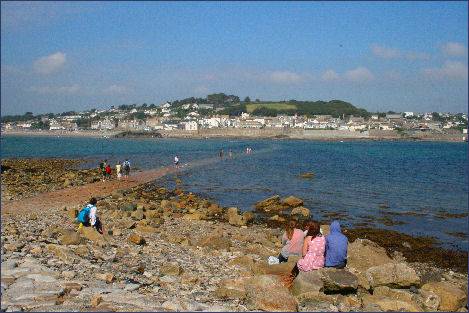
The island, which can claim to be Cornwall's most celebrated landmark, can be reached via the causeway at low tide, a boat service operates across from the characterful town of Marazion at times of high tide.
The mount has been a trading place for tin since the Iron Age and was known to the Greeks and the Romans. According to one legend St Michael is believed to have appeared there in AD 710.
A Saxon Reilgious settlement may have existed on the Mount in the reign of Edward the Confessor and a Saxon grave has recently been discovered on the island which dates to around A.D. 900.
The island was given by Robert Count of Mortain, the half brother of William the Conqueror to the Norman Abbey of Mont St. Michel. Bernard le Bec, Abbot of Mont St. Michel, to which the mount bears a striking resemblance, founded the Priory in 1135, which was later to become a place of pilgrimage in the Middle Ages.
The mount has a colourful and dramatic history, it was captured by Henry Pomeroy on behalf of Prince John, in the absence of Richard the Lionheart, who was engaged in the Third Crusade. As England's relations with France deteriorated throughout the Medieval period St. Michael's Mount began to assume the role of a military centre. In 1473 the Earl of Oxford maintained it as the last pocket of Lancastrian resistance during the Wars of the Roses, after a six month seige the castle surrendered.
The Tudor Pretender Perkin Warbeck occupied St. Michael's Mount in 1497, leaving his wife, Katharine Gordon, at the Mount, while he embarked on his ill fated attempt to seize the English crown. During the reign of Queen Elizabeth I , it was given to Robert Cecil, Earl of Salisbury, by whose son it was sold to Sir Francis Basset. During the English Civil War, his brother, Sir Arthur Basset, held the Mount against the forces of parliament under Colonel Hammond, until July 1646. The Mount was sold to Sir John St Aubyn in 1660 and remained in the possesion of the St Aubyn family up until the twentieth century. The family used it mainly as a summer residence until the eighteenth century, when the fine Victorian apartments were added.
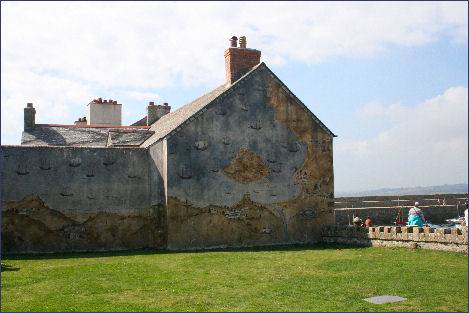
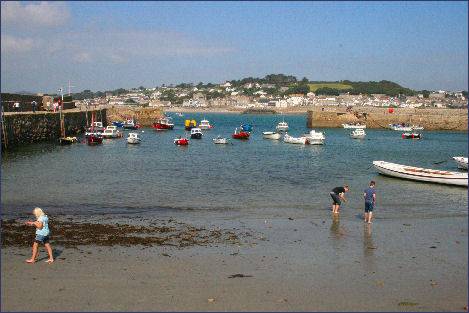
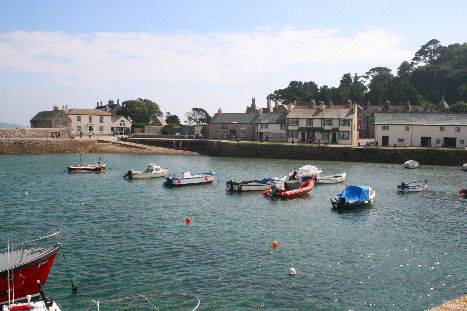
In 1954 the St. Aubyn family entered into a partnership with the National Trust, and the castle and its grounds were opened to the public. Among the rooms now open to the public are the Chevy Chase Room, so named after its superb ornate plaster frieze. The chapel of St. Michael dates from the fifteenth century and has an embattled tower. There are also collections of armour and paintings.to be seen. The gardens feature many sub-tropical species of plants.The walk up to the castle also provides breathtaking views surrounding the island, dolphins and seals may sometimes be seen in the waters below.. The island has a quaint and characterful harbour, with picturesque houses, gift shops and restaurants. Chapel Rock, which stands on the beach, marks the site of a shrine dedicated to the Virgin Mary, where pilgrims once worshipped.
The mount is known in Cornish as Carrack Looz en Cooz, which translates as 'the grey rock in the wood, the name may date back to old folk memories of before Mount's Bay was flooded. The remains of trees are known to have been sighted at low tide on the beach at Perranuthnoe.
It is important to check local tide times if you wish to walk across the causeway to the castle.