St Levan
OS grid ref:- SW 3822
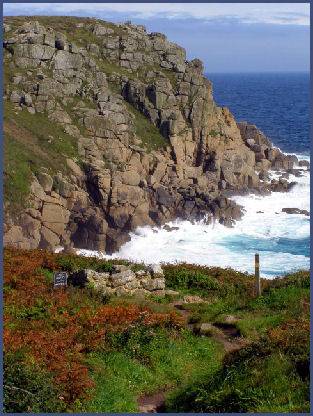 Known in Cornish as Sen Selevan, the small, pleasant village of St. Levan, lies to the east of Sennen Cove and around seven miles from Penzance
In the past the village derived its income from shell fishing. St. Levan has many stunning views of the sea and surrounding cliffs that lead ddown to the harbors, the beaches and coves.
The granite Parish Church of St. Levan is home to the St Levan's Stone, which lies at the south side of the church near to the porch. Legend records the stone was used by the saint as a seat. He is said to have broken it in two with his staff, he prayed over the rock while uttering the following prophecy:-
"When with panniers astrideA pack horse can ride
Through St Levan stone
The world will be done"
In pre-Christian times, the stone was venerated for its powers and particularly in connection with fertility rites.
There were once at least six Celtic crosses in the churchyard. Two of which remain today, the first of these, which measures six feet eleven inches in height is situated to the right of the path leading to the south porch. A second cross may be seen in the churchyard wall, beside the corner entrance stile.
St Levan has pre-Christian holy well, which is one of the most spectacularly placed in Cornwall. As with many of the holy wells of Cornwall, its water is reputed to have healing powers and is still used in the Church for baptisms. The water was believed to cure toothache and eye diseases, while it was claimed that sleeping at the well increased the chances of a cure. The Holy Well of St Levan and the Baptistery lie beside the footpath leading to Porth Chapel Beach. The well can be reached via a flight of granite steps.
Image copyright Jim Champion
St. Levan Church
The first church to occupy the site was constructed in the ninth or tenth century, possibly of thatch and wattle and it is certain that the present church stands on the site of the place where St Levan created a centre of Christianity.
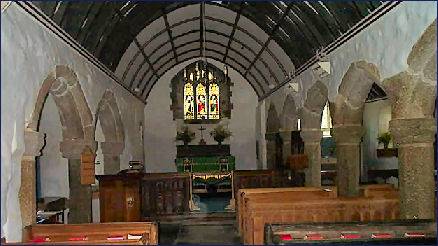
St Levan, named after his great-uncle St Soloman, in the Celtic language, St Selevan, today corrupted into the name St Levan, was born in the sixth century at, it is said, Boslevan, which lies to the east of St Buryan.
A small pre-Norman church was subsequently constructed. The building was extended to roughly what it is today in the fifteenth century. The original timbers with traces of gilding and colouring can still be seen, as well as a carving of a "Green Man", which forms part of a boss overlooking the steps to the altar in the Lady Chapel. was enlarged in the fifteenth century.
The church contains a Norman font, which dates from 1100 to 1130, and may have been used in an earlier Church. The large circular bowl has a lower burden of cable work, and an upper border of chip carved crosses and four flat motifs of stars in circles, there is also a medieval holy water stoup. The bench ends contain some unusual and interesting designs, one depicts two fish, apparently on one hook, recalling one of the legends of St Levan.