Penzance
OS Grid ref:- SW462269
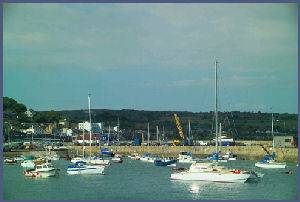 Penzance, the major tourist and commercial centre of West Cornwall, was mentioned in the Domesday Book.
Lescudjack Hill Fort, dating from the Bronze Age, overlooks Penzance Harbour, the hill fort is positioned on the summit of a steep hill in the east of Penzance and consists of a single rampart enclosing an area of 3 acres (12,000 m2).
 The town is known in the Cornish language 'Pen Sans' meaning Holy Headland. It was originally a small fishing community established close to the current Battery rocks and St Antony's Gardens. The first recorded mention of the name Pensans occured in 1284.
Penzance was sacked and left in smouldering ruins after a Spanish raid in1595, but rebuilt extending from the original settlement up through the present Chapel Street over the next 200 years, leaving some unusual and interesting private, public and civic buildings. The town grew in importance, receiving its Royal Charter from James 1 in 1614. During the Civil War, Penzance was sacked by the Parliamentarian forces of Sir Thomas Fairfax apparently for showing kindness to Lord Goring and Lord Hopton's troops during the conflict.
The seafaring nature of the town dominated its development with wharfs, harbour, pubs, warehouses and shops and the early Georgian character of this part of town is well preserved. Further town development came with the railhead being established here in the 1830's when major Victorian influences and prosperity produced some grand Civic buildings, still standing, and the building of the only Promenade in Cornwall. There are also fine Art Deco buildings and a restored Lido built close by the original settlement site.
 The seafront with its promenade and the open-air seawater Jubilee Bathing Pool which is one of the oldest surviving Art Deco swimming baths in the country, was built during Penzance's heyday as a fashionable seaside resort.
The Union Hotel in Chapel Street once housed a Georgian theatre and the Assembly Rooms, reserved for Penzance's gentry. The news of Lord Nelson's death was first announced from the balcony in the Assembly Rooms.
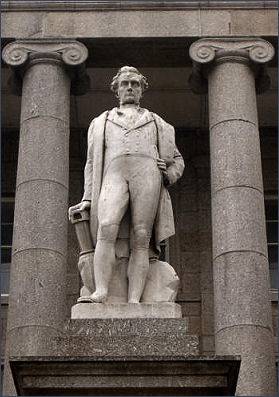
The main street is the curiously named Market Jew Street, which is said to derive from a corruption of the old Cornish 'Marghas Yow', meaning Thursday Market. The street curves up from the quay to the domed granite Market House with its imposing Ionic colonnade, completed in 1838, it was originally built to house a market in the western half of the building and the guildhall in the east. It was the civic centre of Penzance until the construction of St. Johns Hall. The building now serves as a bank, below it stands a statue of Sir Humphry Davy (pictured right).
 Sir Humphry Davy, one of the foremost chemists of the nineteenth century and inventor of the miners lamp was one of Penzance's more famous sons. He was born in a house near to the site of his statue, where he began his experiments. He acquired a knighthood in 1812 for his contribution to science and was later made a baronet for his creation of the miner's safety lamp. One of Penzance's secondary schools is named after the famous scientist.
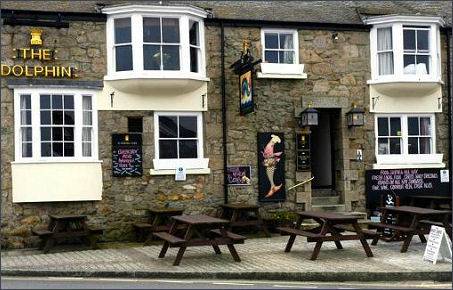
The Dolphin Inn in the town (pictured right) is said to have been the first place in Britain where tobacco was smoked. It is also reputed to have housed Sir John Hawkins during the wars with Spain and in the seventeenth century was the venue for trials over which the Hanging Judge Jeffreys presided.
An eleventh century cross with a wheel head and ornamented panel, stands outside the Penlee Museum in Morrab Road. Known as the Penzance Cross, its base bears the inscription 'Regis Ricati Crux' meaning the cross of King Ricatus. It was removed from the corner of the Green Market in 1807, and later erected in Morrab Gardens in 1899. It was later moved to Penlee Gardens and then transferred to its present position in front of Penlee Museum in 1952.
Elegant Georgian and Regency buildings line Chapel Street, some are built of brick which is faced with granite, a feature that is most unusual in Cornwall. The Union Hotel was where the first news of Nelson's death at Trafalgar was announced from the Minstrel's Gallery in the dining room. Number 25 Chapel Street was the home of Maria Branwell and her sister, Maria married a Yorkshire vicar and became the mother of the famous novelists Charlotte, Anne and Emily Bronte. The house is not open to the public.
Places of Interest
The Egyptian House -
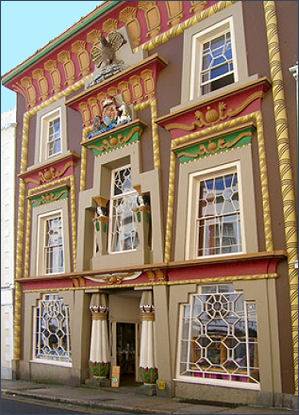 Situated at Nos 6-7, Chapel Street (pictured right), now a National Trust shop, the building dates from 1835 and, a survivor of a style that enjoyed a vogue after Napoleon's campaign in Egypt of 1798, it was built to house a geological Museum, the architect was John Foulton, or Foulston, of Plymouth. The original owner of the house was John Lavin, a mineralologist from Penzance. The building has a highly ornate and colourful facade of lotus columns and stylized cornices. Set in amongst the Egyptian styling and spynx like adornments is the royal coat of arms of George III/William IV.
The Penzance Maritime Museum -
Situated at 19 Chapel Street and well worth a visit, the museum has a surprising interior, re-creating an eighteenth century four deck man-of-war, complete with creaking floorboards and hosts displays of pieces of eight and other artefacts recovered from wrecks off the Isles of Scilly.
Penlee House Art Gallery and Museum
Situated in Morrab Road, The only public gallery in the south-west, display reflecting the history and environment of Penzance. Collection of work by the Victorian Newlyn School of Painting. Set in an elegant Victorian house and park, Penlee House also covers local archaeology and social history, and offers an excellent café and shop.
Trengwainton Gardens-
Unique gardens owned by the National Trust, named for the Cornish 'house of the springs' exotic shrubs and trees, renowned for its rhododendrons, magnolias and camellias. Excellent views. Tea room, shop and plant sales.
Trewidden Gardens -
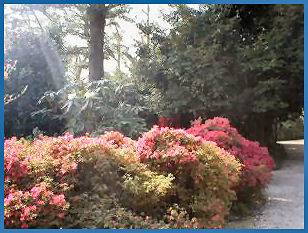 A magnificent spring garden (pictured left) and one of the finest informal gardens in Cornwall, is situated 2 miles west of Penzance, it contains one of the best collections of camellias in the country.Morrab Gardens consist of three acres of a large variety of sub-tropical plants , shrubs and trees which thrive in Cornwall's famously mild climate.
Morrab House
Morrab House with its walled garden was built in 1841 for brewer Samuel Pidwell. On 16 July 1888 the house and gardens was bought by the Corporation of Penzance. Named after the Cornish "mor app" meaning "sea and shore", the gardens are open every day and house the Morrab library.
Events in Penzance
*The Golowan Festival, held in June. During this period both Causeway Head and Market Jew Street are decorated with flowers and banners. The festival reaching a climax on Mazey Day. On this day there are market stalls lining both of these streets, which are closed to traffic. There are colourful parades, street entertainment and musical events.
Pirates, Smugglers and Wreckers of Cornwall